

Some examples of model hyperparameters include:
- The penalty in Logistic Regression Classifier i.e. L1 or L2 regularization
- The learning rate for training a neural network.
- The C and sigma hyperparameters for support vector machines.
- The k in k-nearest neighbors.
The aim of this article is to explore various strategies to tune hyperparameter for Machine learning model.
Models can have many hyperparameters and finding the best combination of parameters can be treated as a search problem. Two best strategies for Hyperparameter tuning are:
GridSearchCV
In GridSearchCV approach, machine learning model is evaluated for a range of hyperparameter values. This approach is called GridSearchCV, because it searches for best set of hyperparameters from a grid of hyperparameters values.
For example, if we want to set two hyperparameters C and Alpha of Logistic Regression Classifier model, with different set of values. The gridsearch technique will construct many versions of the model with all possible combinations of hyerparameters, and will return the best one.
As in the image, for C = [0.1, 0.2, 0.3, 0.4, 0.5] and Alpha = [0.1, 0.2, 0.3, 0.4].
For a combination C=0.3 and Alpha=0.2, performance score comes out to be 0.726(Highest), therefore it is selected.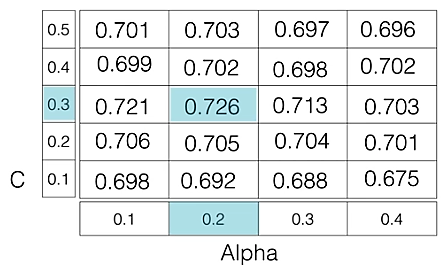
Following code illustrates how to use GridSearchCV
# Necessary imports from sklearn.linear_model import LogisticRegression from sklearn.model_selection import GridSearchCV # Creating the hyperparameter grid c_space = np.logspace(-5, 8, 15) param_grid = {'C': c_space} # Instantiating logistic regression classifier logreg = LogisticRegression() # Instantiating the GridSearchCV object logreg_cv = GridSearchCV(logreg, param_grid, cv = 5) logreg_cv.fit(X, y) # Print the tuned parameters and score print("Tuned Logistic Regression Parameters: {}".format(logreg_cv.best_params_)) print("Best score is {}".format(logreg_cv.best_score_)) |
Output:
Tuned Logistic Regression Parameters: {‘C’: 3.7275937203149381}
Best score is 0.7708333333333334
Drawback : GridSearchCV will go through all the intermediate combinations of hyperparameters which makes grid search computationally very expensive.
RandomizedSearchCV
RandomizedSearchCV solves the drawbacks of GridSearchCV, as it goes through only a fixed number of hyperparameter settings. It moves within the grid in random fashion to find the best set hyperparameters. This approach reduces unnecessary computation.
Following code illustrates how to use RandomizedSearchCV
# Necessary imports from scipy.stats import randint from sklearn.tree import DecisionTreeClassifier from sklearn.model_selection import RandomizedSearchCV # Creating the hyperparameter grid param_dist = {"max_depth": [3, None], "max_features": randint(1, 9), "min_samples_leaf": randint(1, 9), "criterion": ["gini", "entropy"]} # Instantiating Decision Tree classifier tree = DecisionTreeClassifier() # Instantiating RandomizedSearchCV object tree_cv = RandomizedSearchCV(tree, param_dist, cv = 5) tree_cv.fit(X, y) # Print the tuned parameters and score print("Tuned Decision Tree Parameters: {}".format(tree_cv.best_params_)) print("Best score is {}".format(tree_cv.best_score_)) |
Output:
Tuned Decision Tree Parameters: {‘min_samples_leaf’: 5, ‘max_depth’: 3, ‘max_features’: 5, ‘criterion’: ‘gini’}
Best score is 0.7265625
 DataTask